• Skip to main content
  • Skip to footer
Eco Friendly CBD OIL

Eco Friendly CBD OIL

The Best Eco Friendly CBD Oil

  • Home
  • CBD Health
  • Cannabis News
  • Contact

CBD OIL

Congress Passes MORE Act | Cannabis Industry Journal

December 4, 2020 by CBD OIL

A little over a year ago, the House Judiciary Committee approved the Marijuana Opportunity Reinvestment and Expungement (MORE) Act by a 24-10 vote, marking the first time in history that a congressional committee approved a bill to legalize cannabis. Fast forward a year, and the bill is making history again.

Rep. Earl Blumenauer (D-OR) donning his cannabis mask as he presides over the Congress

Rep. Earl Blumenauer (D-OR), a co-sponsor for the bill and co-chair of the Congressional Cannabis Caucus, donned a cannabis leaf mask as he presided over the floor debate in the House of Representatives on the morning of December 4. After the debate on the floor, the House of Representatives voted 228 to 164 to pass the MORE Act.

While this vote is historic and should certainly be celebrated, it is unfortunately a mostly symbolic win. During the Post-Election Analysis episode of the Cannabis Quality Virtual Conference, Andrew Kline, director of public policy at the National Cannabis Industry Association (NCIA), told attendees that this bill always had strong support in the House, but not enough support in the Senate. “You know I think there is pretty much a 100% chance of it passing the House,” Kline said back in early November. “I don’t think they would’ve scheduled the vote if they didn’t have the votes.”

The House voted 228 to 164 to pass the MORE Act.

Kline told attendees that Republican priorities are most likely to blame when the MORE Act fails to get enough support in the Senate. “The bigger question is what happens when it reaches the Senate and I think it is all but dead when it gets there,” says Kline. “Mitch McConnell has been reluctant to move any legislation over the past four years. He’s really ignored most legislation and particularly any legislation he doesn’t like. He doesn’t like cannabis and it appears to me he barely even likes hemp. He’s really not even fighting for the hemp industry.”

While the MORE Act likely doesn’t have a chance in the Senate, it passing the House is still a monumental moment in cannabis legalization history. This marks the first time in 50 years that Congress has revisited cannabis prohibition, according to Justin Strekal, political director of NORML. “This is a historic day for marijuana policy in the United States,” says Strekal. “By establishing this new trajectory for federal policy, we expect that more states will revisit and amend the archaic criminalization of cannabis, establish regulated consumer marketplaces, and direct law enforcement to cease the practice of arresting over half a million Americans annually for marijuana-related violations – arrests which disproportionately fall upon those on people of color and those on the lower end of the economic spectrum.”

Along with all of the success that cannabis had on Election Day, including five states legalizing it, the House passing this legislation is a symbol of shifting attitudes toward cannabis and serious progress on the federal legalization front.

The real question that should be asked is what will the 117th Congress do? If Democrats gain control in the Senate following the runoff elections in Georgia, it could reinvigorate the momentum behind this bill and offer a renewed breath of life.

Filed Under: Cannabis News

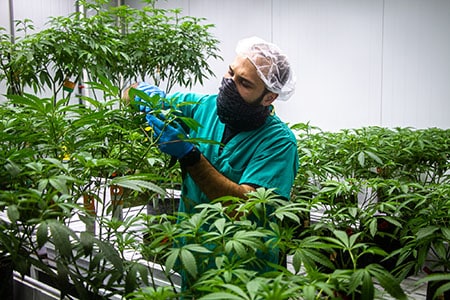
Cannabis Cultivation Lighting Retrofit: 7 Tips

December 4, 2020 by CBD OIL

Editor’s Note: This article was originally published in the November 2020 State of the Lighting Market, produced by Cannabis Business Times and made possible with support from Fluence by OSRAM. Read the full report in the November issue of CBT.

As chief scientist for LivWell, Andrew Alfred’s priorities include testing any potential facility update or growing change before implementing it at scale.

For the past seven years, one of the inputs Alfred has researched extensively is lighting. Alfred was interested specifically in light-emitting diode (LED) technology for its energy-saving potential, but before considering a widespread change for the vertically integrated company’s 2-acre canopy in its flagship cultivation facility in Denver, he wanted to be sure plant performance wouldn’t suffer.

“Seven years ago, one of the LEDs that we had in our flower rooms looked like a car engine. It weighed 80 pounds,” Alfred says. “We didn’t know how to use the LED light. We didn’t know that you had to raise the temperatures in your room to account for the loss of radiant heat.”

Another common mistake cultivators made in the early days was simply swapping out one grow light for an LED light without calculating lighting density, which was “a growing pain that the industry had to reconcile.”

However, both LED technology and cultivator knowledge have improved dramatically and quickly, Alfred says, and that includes everything from the lights to the mounting hardware. Working with nearly 20 North American and European LED lighting manufacturers, LivWell has conducted multiple cannabis trials over the years, adjusting environmental conditions to optimize plant performance.

Because of the improvements in yield and energy savings, for the past five years, the company has been incrementally converting its entire Denver facility to LED lighting and has almost completed the transition.

Here, Alfred shares some key takeaways he’s learned and tips for cultivators who are considering a lighting retrofit in an existing facility.

1. Experiment before implementing any sweeping change.

Before updating lighting, Alfred recommends requesting samples or investing in a few lights and testing them first, comparing them to current fixtures and observing metrics like yield. Ensuring all parameters are adjusted for new lights, especially temperature, is also important when running trials “to make sure it’s a fair fight,” he says.

“The important thing to remember with temperature is that it is all about the plant, not just the temperature of the air. You can use tools like infrared thermometers to measure canopy temperature,” he says. “Given the same air temperature, a plant under LED could easily be 5 degrees [F] cooler than a plant under HID [high-intensity discharge],” which could negatively impact yield. Raising the air temperature, targeting ranges in the low 80s, can be a successful strategy for growers.

2. Create detailed plans and review them with all involved.

Replacing existing growing lights for LEDs has been a five-year-plus project for LivWell, and in a few months, the transition will be complete. Creating a plan was integral for success, Alfred says, as was reviewing those plans with the lighting manufacturer and engineers. “You have to bring a lot of people to the table to plan that transition,” he says. “We had to coordinate with all parties involved, such as the lighting manufacturers, electricians, [environmental] controls company, permitting office and our production staff.”

3. Establish a relationship with your utility company account manager and ask about rebates.

Once LivWell reviewed and finalized the plans with the lighting manufacturer and engineers, they sent the details to their utility company for rebate pre-approval. Establishing a relationship with your utility company account manager is important for many reasons, whether you are planning on updating lighting or not, Alfred says. When LivWell first explored converting to LEDs, Alfred contacted his account manager to discuss the project and if they qualified for custom rebates.

Colorado was still a young market then, and the electrical engineers from the utility company were accustomed to measuring light using lumens, not photosynthetically active radiation (PAR), Alfred explains. By establishing a partnership with the company, he was able to demonstrate the importance of PAR and the significant savings from LEDs.

Now, engineers from the utility company regularly visit LivWell to review the lighting work and measure energy usage. And for every LED light LivWell has purchased, the utility provides 25% to 40% cash back on the investment.

“It takes a big burden off their power grid,” he says. “It’s better for our business, and it’s better for the utility company.”

4. Install incrementally to minimize downtime.

Once a rebate program is established, the operations team steps in to coordinate the installation, permitting requirements and construction details.

Minimizing the time that cultivation areas are offline is the most challenging aspect of a retrofit, but LivWell was able to do this by working through careful logistics and installing new lighting incrementally. For LivWell, sometimes that meant using a flowering room as a vegetative room temporarily while the actual vegetative room was being converted.

“If all equipment is staged and permits are in order, it can easily be done in under a month. If any of those pieces are missing, it can take a lot longer,” Alfred says. “We had to be flexible with what kind of cultivation we did where to keep our production cadence going.”

Because LivWell runs a perpetual harvest, sometimes they worked row by row, converting lights as each bench was harvested, using tarp barriers as temporary walls to protect plants.

“It really is kind of a monumental effort, and when it’s done too casually, it might result in lost production,” he says. “A good general contractor can quarterback the coordination.”

5. Recalculate sensible loads, and consider other important measurements.

Because HVAC equipment is designed and set to work at specific sensible and latent loads, LivWell needed to work with engineers to recalculate the ratios based on the new lighting that does not emit as much radiant heat.

“A more technical challenge was figuring out how to keep our humidity setpoints while removing 40% of our sensible heat load,” Alfred says. “We worked with our engineers to assess our HVAC’s equipment to handle this change and, in some instances, found that we needed to upgrade our units. It’s very important that anyone considering retrofitting to LEDs do this calculation beforehand.” In some cases, it will require an equipment upgrade, or, at the very least, a setpoint change. “You don’t want to go in blind without having thought through that first,” Alfred says.

6. For vertical systems, calculate humidity, temperature, and extra floor space required.

Because LEDs emit far less radiant heat, growers who convert to this technology sometimes explore using vertical (tiered) growing systems, as lights can be closer to the plants. Although “the sky is the limit” regarding how many tiers cultivators could theoretically have, Alfred recommends caution here. LivWell sticks to two tiers in flower and stops at three in veg.

“The higher you go, the more challenging it gets,” he says. “It can be difficult to make sure temperature, humidity and air movement are equivalent across all tiers. You don’t want your top tier to be a different temperature than your bottom tier, which can happen, especially as you get taller and taller cultivation systems. You can get these stratifications of environment. It’s just like switching to LED, and if you’re switching to vertical growing and LED at the same time, there’s an extra layer of making sure that you do your homework.”

Cultivators must account for extra floor space needed for equipment in multi-level systems, as well, Alfred says.

“Consider how aisle and bench widths need to change between single-level and multi-level systems. You’re going to need wider aisles for bringing a roller ladder … and you’re typically going to want narrower benches to access the plants,” he says. “This means that going vertical doesn’t simply translate to two times or three times more canopy.”

7. Have backup plans–and lights.

With all that’s involved in a lighting conversion, unexpected problems can come up, and that includes issues with lighting equipment.

“Have a tough conversation with your lighting manufacturer about their equipment failure rates,” Alfred says. “Less than 1% is a bare minimum starting point. Then, make sure the manufacturer sends surplus inventory to anticipate the need to immediately swap out lights that have issues. If a manufacturer can’t speak to what their failure rates are, that’s a red flag that they don’t have a lot of experience with quality control and field installations at scale.”

Retrofitting an existing facility with live plants can be challenging, Alfred says, but it’s been worth it for LivWell.

“The LEDs often pay for themselves in 12 months just in energy savings alone,” he says.

Filed Under: Cannabis News

Aphria Closes Acquisition of SweetWater Brewing Company

December 4, 2020 by CBD OIL

Licensed cannabis companies pay more than their fair share of taxes thanks to the business deduction restrictions placed on them by IRS Tax Code Section 280E. That tax law prevents cannabis producers from taking any deduction or credit unrelated to the cost of goods sold (COGS). With some well-thought-out corporate structure, however, cannabis cultivators can find ways to reduce their overall tax burden.

The Research and Development (R&D) Tax Credit is one such vehicle that potentially is available to cultivators, according to Jonathan Storper and Daren Shaver, attorneys with California-based Hanson Bridgett.

“What the R&D credit is designed to do is reward innovation and problem-solving. And there’s really no industry limitation,” Shaver tells Cannabis Business Times and Hemp Grower. “Any business that is eliminating technical uncertainty in the development of products or experimenting and relying on science to really develop a product [is] a very good candidate for an R&D credit.”

Expenses relating to breeding programs, equipment modification and/or design, and developing novel or innovative consumer products can all be used to apply for an R&D tax credit, the attorneys say, as long as the corporate structure separates the plant-touching business from the R&D business. “The corporate structure is extremely important in this kind of thing,” Storper stresses.

Having multiple corporate entities is not new to the cannabis industry and is highly common in other industries. For example, some cannabis companies have created separate corporate entities under which real estate assets are held. That real estate company, which leases the property to the cultivation operation, can then take deductions (as it is a federally legal business) that would not have been available if the cultivation operation held those assets. Thus, that structure lowers the overall tax burden for the cultivation business.

The same idea applies to the R&D credit, the attorneys say.

“The better approach for somebody who’s looking to take the R&D credit is to achieve as much separation [between companies] as possible,” Shaver says.

Easier Path for Hemp Companies

Hemp cultivation companies have an easier path to applying for and receiving these R&D tax credits since hemp cultivation is legal at the federal level and 280E has not applied since the 2019 tax year.

However, Storper and Shaver both emphasize the importance of excellent bookkeeping to keep track of what qualifies as an R&D expense and what does not. “Recordkeeping becomes very important on something like this. … Bifurcating expenses between good R&D expenses and otherwise is very important,” Shaver says.

For example, if a hemp (or cannabis) company has an employee whose sole job is to oversee and conduct research and analysis, that employee’s salary could be used in applying for an R&D tax credit, Shaver explains. If that employee is a part-time researcher, then the company should keep track of how much of that employee’s time is spent on R&D and only use that portion of the employee’s salary when applying for the credit.

Costs for supplies and equipment also can be eligible as long as the research being done is science-based. “I don’t think throwing some extra fertilizer, for example, would be enough [to qualify for an R&D credit],” Shaver says.

If cannabis and hemp cultivators structure their corporate entities correctly and apply proper due diligence in tracking expenses, the IRS is more likely to grant the credit, especially if the research has benefits outside of the cannabis industry (e.g. a new way to emulsify cannabinoids (hydrophobic compounds) into water would have applications to the entire beverage and supplement industry). With that in mind, they advised companies interested in applying for R&D credits take the time to plan out their efforts early in the tax year. “It’s always better to do early planning than try to look back and ask for forgiveness,” Storper says.

Anyone looking to leverage the R&D tax credit also should consult with their legal and accounting team, they say, to ensure the corporations are properly structured and separated.

Filed Under: Cannabis News

HUB International Chooses Simplifya for Ongoing Cannabis License Verification of Cannabis Clients

December 4, 2020 by CBD OIL

Licensed cannabis companies pay more than their fair share of taxes thanks to the business deduction restrictions placed on them by IRS Tax Code Section 280E. That tax law prevents cannabis producers from taking any deduction or credit unrelated to the cost of goods sold (COGS). With some well-thought-out corporate structure, however, cannabis cultivators can find ways to reduce their overall tax burden.

The Research and Development (R&D) Tax Credit is one such vehicle that potentially is available to cultivators, according to Jonathan Storper and Daren Shaver, attorneys with California-based Hanson Bridgett.

“What the R&D credit is designed to do is reward innovation and problem-solving. And there’s really no industry limitation,” Shaver tells Cannabis Business Times and Hemp Grower. “Any business that is eliminating technical uncertainty in the development of products or experimenting and relying on science to really develop a product [is] a very good candidate for an R&D credit.”

Expenses relating to breeding programs, equipment modification and/or design, and developing novel or innovative consumer products can all be used to apply for an R&D tax credit, the attorneys say, as long as the corporate structure separates the plant-touching business from the R&D business. “The corporate structure is extremely important in this kind of thing,” Storper stresses.

Having multiple corporate entities is not new to the cannabis industry and is highly common in other industries. For example, some cannabis companies have created separate corporate entities under which real estate assets are held. That real estate company, which leases the property to the cultivation operation, can then take deductions (as it is a federally legal business) that would not have been available if the cultivation operation held those assets. Thus, that structure lowers the overall tax burden for the cultivation business.

The same idea applies to the R&D credit, the attorneys say.

“The better approach for somebody who’s looking to take the R&D credit is to achieve as much separation [between companies] as possible,” Shaver says.

Easier Path for Hemp Companies

Hemp cultivation companies have an easier path to applying for and receiving these R&D tax credits since hemp cultivation is legal at the federal level and 280E has not applied since the 2019 tax year.

However, Storper and Shaver both emphasize the importance of excellent bookkeeping to keep track of what qualifies as an R&D expense and what does not. “Recordkeeping becomes very important on something like this. … Bifurcating expenses between good R&D expenses and otherwise is very important,” Shaver says.

For example, if a hemp (or cannabis) company has an employee whose sole job is to oversee and conduct research and analysis, that employee’s salary could be used in applying for an R&D tax credit, Shaver explains. If that employee is a part-time researcher, then the company should keep track of how much of that employee’s time is spent on R&D and only use that portion of the employee’s salary when applying for the credit.

Costs for supplies and equipment also can be eligible as long as the research being done is science-based. “I don’t think throwing some extra fertilizer, for example, would be enough [to qualify for an R&D credit],” Shaver says.

If cannabis and hemp cultivators structure their corporate entities correctly and apply proper due diligence in tracking expenses, the IRS is more likely to grant the credit, especially if the research has benefits outside of the cannabis industry (e.g. a new way to emulsify cannabinoids (hydrophobic compounds) into water would have applications to the entire beverage and supplement industry). With that in mind, they advised companies interested in applying for R&D credits take the time to plan out their efforts early in the tax year. “It’s always better to do early planning than try to look back and ask for forgiveness,” Storper says.

Anyone looking to leverage the R&D tax credit also should consult with their legal and accounting team, they say, to ensure the corporations are properly structured and separated.

Filed Under: Cannabis News

Greentank Technologies Receives Cannabis Research License

December 4, 2020 by CBD OIL

Editor’s note: This story was updated at 5:30 p.m. Dec. 2 to include further detail on the vote, including statements from cannabis companies and CND delegates.

In a historic vote, the United Nations Commission for Narcotic Drugs (CND) voted narrowly Dec. 2 to remove medicinal cannabis from Schedule IV of a 1961 treaty on narcotic drugs.

The CND, a commission based in Vienna with members from 53 different countries, voted on six different cannabis-related recommendations presented by the World Health Organization (WHO). Those recommendations outlined protocol for internationally regulating the medical use of different parts of the plant, including cannabis as a whole, cannabidiol (CBD) and tetrahydrocannabinol (THC). (Kenzi Riboulet-Zemouli, a Barcelona-based independent researcher and cannabis advocate, has a breakdown of what each recommendation would do on his blog.) 

During its meeting Dec. 2, the CND also rejected a recommendation from WHO to schedule medical CBD, leaving it outside of treaty controls. 

However, the vote to classify cannabis remained the main topic of the recent meeting. The CND voted 27-25 to reclassify both cannabis and cannabis resin for medicinal purposes from Schedule IV to Schedule I, removing them from being regulated like some of the world’s most dangerous drugs. (The CND’s scheduling system works in an opposite sequence when compared to the U.S. Controlled Substances Act.)

In an article on Fundación Canna, Riboulet-Zemouli writes “WHO’s recommendations were unprecedented since the Single Convention on narcotic drugs passed in 1961.”

Experts say this move could not only improve accessibility to medical cannabis across the world, but also affirms international support of scientific evidence on cannabis as a medicine.

“The removal from Schedule IV is … phenomenal news for millions of patients around the world and a historical victory of science over politics,” Riboulet-Zemouli says in a press release.

What the Vote Means for Cannabis in the U.S.

Global accessibility, however, still depends on individual countries’ laws, as each member of the UN holds the power to determine its own cannabis regulations.

As Joshua Horn and Jonathan Dolgin of Fox Rothschild LLP write on Cannabis Business Times, the U.S. has proven to have an influential role in international drug regulations. The U.S. voted for the cannabis reclassification—a move that could signify the country’s interest in moving toward cannabis decriminalization or all-out legalization. (Relatedly, members of the U.S. House Rules Committee also voted Dec. 2 to advance an act that would remove marijuana from the federal Controlled Substances Act.)

“If I had to predict, I think the lower hanging fruit in this country to address is further decriminalizing cannabis as opposed to removing it altogether tomorrow from [the Controlled Substances Act],” Horn tells Cannabis Business Times and Hemp Grower.

U.S. cannabis businesses have embraced the reclassification from the CND. While the move was largely symbolic, cannabis business leaders say they are hopeful for what it represents.

“We welcome the rescheduling of cannabis to only [Schedule 1], as this recognizes the positive impact cannabis has today for thousands of suffering patients,” says Dirk Heitepriem, Canopy Growth’s vice president of government and stakeholder relations for Europe, the Middle East and Africa. “We hope this will empower more countries to create frameworks which allow patients in need to get access to treatment.”

Other recommendations that failed to pass were removing extracts, tinctures and THC isomers from Schedule I status, as well as removing delta-9 THC from its status as a Schedule II substance. (The U.S. voted to remove extracts and tinctures, but voted against removing delta-9 THC.)

“…Government’s failure to accept the more advanced WHO proposals is disappointing and represents a lost opportunity to make the treaty best fit [its] purpose,” Riboulet-Zemouli points out in a press release. “However, none of today’s negative votes will result in any worsening of controls over cannabis whatsoever.”

What the Vote Means for CBD in the U.S.

It’s important to note that the CND was only voting on cannabis and its derivatives that are used for medicinal purposes. Recreational marijuana, hemp and its derivatives, and CBD added to food, topicals and dietary supplements were not subject to CND’s vote. (Hemp and its derivatives are only considered controlled substances by the CND when they are used for medicinal or scientific purposes.)  

This is an issue that became muddled even among members of the CND, Riboulet-Zemouli writes on Fundación Canna, contributing to the commission’s long-delayed vote.

CBD medicinal products, such as Epidiolex, were up for vote because these medications can contain up to 0.2% THC. WHO’s recommendation proposed that these medications be exempt from CND’s purview—specifically, that “preparations containing predominantly cannabidiol (CBD) and not more than 0.2 per cent of delta-9 tetrahydrocannabinol are not under international control.”

As such, the hemp and CBD industries in the U.S. and elsewhere are largely unaffected by the vote.

The U.S. delegate said they rejected the CBD proposal “on legal and procedural grounds.”

“Cannabidiol has not demonstrated abuse potential, and it is not our position that cannabidiol should be or is under the control of the international drug conventions,” the delegate said. “…We believe the member states are capable of determining for themselves what should be considered a ‘pure’ cannabidiol preparation for domestic enforcement purposes based on analytical capacity, abuse liability, and prioritization of prosecutorial resources.” 


Filed Under: Cannabis News

Leaders in Infused Products Manufacturing: Part 5

December 3, 2020 by CBD OIL

Cannabis infused products manufacturing is quickly becoming a massive new market. With companies producing everything from gummies to lotions, there is a lot of room for growth as consumer data is showing a larger shift away from smokable products to ingestible or infused products.

This is the fifth and final article in a series where we interview leaders in the national infused products market. In this final piece, we talk with Lisa McClung, CEO, and Glenn Armstrong, senior advisor at Coda Signature. Lisa got started with Coda in 2019 as a board member after transitioning from an executive role at Wrigley. She now heads up the company as CEO and President. Glenn has deep experience in product development and innovation with brands such as General Mills, Whirlpool and Wrigley.

Aaron Green: Okay, great let’s get started here. So we’ll start with Lisa. How did you get involved at Coda?

Lisa McClung, CEO of Coda Signature

Lisa McClung: I was lucky. Based on my experience, I was originally asked to be on the board of Coda. I’ve served on nine company boards in addition to my career as an executive at General Electric and at the Wrigley Company where I was heavily involved with innovation. The Board then asked me to consider stepping in as CEO after I’d been working there for six months. I was just overwhelmingly complimented that they considered me and I feel incredibly lucky to be here.

Aaron: Okay, great. Glenn, how did you get involved in Coda?

Glenn Armstrong: We’ve known each other for a long time at Wrigley. I was in innovation for the confectionery side and worked very closely with Lisa. When she became a board member, she asked me to do some advising for her. I’m new to the cannabis industry so, I was really excited about doing something different. When Lisa became CEO, she asked me if I would help her.

Aaron: How do you think about differentiating in the market?

Glenn: I spent 90% of my career on the innovation side working with companies like General Mills, Quaker Oats and Amway. When I think about how to differentiate almost any company I always focus on innovation. In the cannabis industry, everybody’s got gummies and chocolates but you’ll hear people talking about “gummies are going away.” No, you’ve just got to innovate, right? It’s like the carrot peeler from 20 years ago. It used to sell for about 25 cents, and it was all steel and now they sell for $10.99. Who would have known?

Glenn Armstrong, Senior Advisor at Coda Signature

I believe anything can be innovative. When I looked at the gummies I asked, “what we learned at Wrigley, can we bring into Coda that currently is not in this industry?” Think about various gums and how they can change flavors over time like Juicy Fruit which dissipates really quickly and that’s just how the flavor is.

Or, there are other ways like spearmint. You can get an initial boost and then extend that flavor by encapsulations. I don’t see much of that in the cannabis industry. It’s just taking what’s out there from flavor companies that people like and getting them into this market.

Aaron: Awesome. Do you have any particular technologies or work or products from other industries that really interest you?

Glenn: I would say it’s going to be from the pharmaceutical industry. You think about THC and CBD being so hydrophobic. With chocolate, it’s not such a hard thing to get into. If you try to get those kinds of compounds into aqueous solutions though it can be a challenge, the drug industry has been doing it for years! So, to me, delving into some of their patents and some of their ideas, that’s one of the most powerful industries I see where we could utilize their technologies to advance the industry. I expect big pharma to get into this. We can start looking at what they’re doing that we can leverage quickly to get into Coda products.

Lisa: We’re not necessarily a pharmaceutical brand, but we are committed to helping people live and feel better. It really is about how you weave cannabis into everyday life?

Coda’s line of chocolate bars

We have a platform of very indulgent products, which is our chocolates ranging from truffles to bars. We also are building our non-chocolate portfolio to include other ways to enjoy cannabis in their daily life. And then to Glenn’s point, I think there’s ideas and technologies from the pharmaceutical area, there’s also things that have been in the food industry for years that provides sensations and experiences.

I think part of our goal is “how many of the five senses can we touch from people in creating product?” The feel of something in your mouth heating, cooling. Not just the psychoactive aspect of it, but the complete end-to-end experience.

These are all dynamics of us delivering the “live and the feel” piece of it. Then people can either use them from a lifestyle perspective for enjoyment, or a medical perspective. Our job is to provide consumers choices and options that provide those type of experiences.

Glenn: If you have a product that’s supposed to “reduce anxiety” why not start with the slight warming of the mouth? Something that feels calming long before the THC or CBD kicks in? Then have a flavor come up that just feels warm and comfortable. By combining all five senses, you have a product that really does something for your consumer.

Aaron: Thanks for that! What’s your process for creating a new product at Coda?

Lisa: Well, I think everybody talks about brainstorming sessions like innovation is something that just pops up. I think innovation has three legs to it. One is really customer-driven. So, we have to produce products that help our retailers make money, and that deliver really good experiences to consumers that we jointly serve.

The second piece of it is thinking about the discipline of innovation. So, when we make a product, what technologies do we bring to bear, can we scale them, and can we produce them at the right price point and delivery?

Coda Signature Fruit Notes

Then the last piece is the fun piece, trying to listen to what is and isn’t being said in the market to really try to be a solutions company.

We spend a lot of time listening and watching the market to figure out where we can anticipate things. We used to call it “problem detection” at Wrigley.

One project that Glen and I worked on was a mint that was designed really around adult usage in more professional situations. So, meaning the shape of the mint needs to be tucked in your cheeks so you couldn’t see it. And the packaging of it was something you could surreptitiously pop underneath the desk because we were designing it for people to use as really a business tool. You don’t think of mints as a business tool, but they really are, they give you more confidence with breath-freshening and you don’t necessarily want to hold that out with everybody else.

Some problems are about how to make a product more fun with our fruit. I can put pineapple jalapeño in my mouth and have a literal popping experience, which adds to my enjoyment of that experience.

The last piece is not to do too many products. One of the things that I think of in cannabis is that everybody’s still learning. It’s such a wide-open space, in some cases, that you also have to kind of pick what you do well. So, sticking close to our brand and what we stand for is also something that we’re trying to do. We’ve actually pulled in our SKUs recently and are trying to focus on a platform of indulgent experiences and of lifestyle products. We try not to do everything that we see out in the market and focus only on the things that we do well that solve problems for our consumers.

Glenn: From my perspective — I am not a big process person — I think the best way to do it is to say, “okay, we’ve got these products. We could look at technology, we could look at something else, but let’s just go scour what’s out there. And let’s get outside of our industry.” Look outside your own game, and see what you can use.

Discovering how to use these technologies in a gummy or chocolate as opposed to just drugs isn’t rocket science. My biggest avenue is looking outside and finding what you can apply as opposed to trying to reinvent everything.

Aaron: We’ve focused on the front end of innovation. Can you articulate on the back-end how that moves into product development, manufacturing and commercial launch?

Lisa: We have a new product pipeline with a Stage-Gate process where we will have a number of ideas and whittle them down on certain criteria.

Sometimes the ideas start with the technology and not the market. Glenn will find something and say, “Hey, this is going on, should we be thinking about this in cannabis?” It allows our each of our teams to come up with how they can make it work.

Then, as that product passes through the next stage-gate, we’re looking at the actual economics of the product, and how it fits relative to our other products all while we’re getting consumer input.

We get to that point in the process when we start trialing with consumers to help decide. And sometimes you get the best idea in the world, and then it’s not going to work so in some cases so you put it back in the pantry.

I never like to say that we don’t take an idea forward, even products that we may have taken off the market, we say “we freeze products, we don’t cut products!” because our goal is to have options. Our discipline is around a Stage-Gate process tied to our business goals and objectives. It’s also about playing around with concepts and seeing what materializes.

Glenn: There is this whole notion of a process, there’s a Stage-Gate, but before that, it’s a lot of playing around. What Lisa and I’ve recently worked on was making innovation a way of life so that every time you see something, you say something.

“We don’t think of innovation solely as the next flavor that’s going to be on the shelf.”We always gave people permission to play in the web.The reason brainstorming sessions don’t tend to work, is we expect people to become innovative in these next five hours.

So, if you think of innovation as a way of life, then it becomes what you do daily, and you look at things differently. I like to say when you’re driving home, go a different route, because you never know what you’re going to see. When you get out of that habitual mindset, you’ll think about your business differently, almost naturally. Innovation — this way of life — is one of our buzzwords.

Lisa: I think building that innovative culture is a responsibility, but also a challenge for a company like Coda. I mean, we’re not new. We’ve been around five, six years and we have some of the leading chocolate bars out there. We’re known for flavor systems.

Where our goal is to create a culture of innovation, you get these little pockets of creativity and innovation, and then it starts snowballing. You build on it, get people excited about it, and move it forward. That’s how everybody gets involved in innovation.

One of the goals of that pipeline process is to combine inspiration and discipline. But you don’t just want to be innovative in the next flavor. That isn’t doing enough for our consumers. We’ve educated them on the potential flavors could bring. But now we really want to be much more innovative across the board and see what kind of culture of innovation Coda can do.

We’re looking at the packaging, how we interact with retailers, how we use digital messaging to support our retailers and support our products. We don’t think of innovation solely as the next flavor that’s going to be on the shelf.

Aaron: From a supply chain perspective, how do you go about sourcing ingredients?

Lisa: We have some wonderful partners that have been with us at Coda. People that bring us chocolate from other parts of the earth.

We continue to keep building our ecosystem of partners. We look at different flavor houses and different food type researchers to be partners with us to broaden our ecosystem. It’s something that’s very much top of mind, even more so during COVID, because we’re feeling  very fragile about our supply chains.

Glenn: Yeah, I think Lisa, that’s one thing you and I bring, not only to Coda, but I think to the cannabis industry, is the whole CPG discipline of how we look at suppliers and procurement. We need to go out there find some smaller flavor labs with incredibly creative folks.

I think the whole notion of expanding the supplier and vendor base, is pretty unique in this industry and that’s one of the strengths we bring to Coda.

Lisa: Our goal is to really create an ecosystem of different suppliers. I just think that that’s something other industries — you talked about pharmaceuticals earlier — have done. Cannabis is just starting to get there, but that’s where you get exponential opportunities.

We’re really looking at cross-functional and interdisciplinary teams with outside partners. Cannabis is at the stage now where I think it’s looking for more sophisticated technologies and new ways of deploying. We’re also really interested, as Glenn said, in some of the younger, more entrepreneurial firms that want to possibly expand their reach into cannabis as well.

Aaron: Okay, great. So my next question is can you give me an example of a challenge that you run into frequently? And this can be either a cannabis challenge or a business challenge?

Lisa: I think one of the challenges that cannabis faces in general is educating consumers about our market. One of the opportunities we have is to bring people into the market. We’re at the same time developing products for people who are in the cannabis space and are active users and have varying degrees of understanding of how they’re using the category in their daily lives.

We’re also trying to create products and education to invite people into the cannabis market. That’s a different challenge than if you’ve had an Oreo cookie, and people kind of understand cookies. They understand Oreos, and then they understand organic Oreos and all the other permutations of two chocolate cookies with a vanilla thing in between. Our goal is to expand the ability for people to access cannabis in their lives.

That is a very unique business problem. And it does represent a bit of a screen, are you going to do some of your products for more sophisticated users and others for less sophisticated users?  Cannabis has consumers that have been taught essentially to think about milligrams; there’s one of the key components of choice. People will look at the product and flavor, and then they look at the milligrams and the price point.

That’s very unique to what we would find on CPG. You don’t necessarily look at dollars per milligram when you buy a cookie. So, if you’re trying to make a premium product with premium flavors, how do you say, “Well, yeah, there’s dollars per milligram, but this product has all these other technologies to create the warming or whatever.” “Innovation in products and new categories is critical to get the industry beyond common confections.”

So you kind of have a dual issue. You’re trying to get people educated on a new category and how they use it. But the education of the consumer in terms of the potential and the possibilities that they can access is going to be very important.

Aaron: What trends are you following in the industry?

Lisa: Beyond paying close attention to legalization progress across the country and monitoring how states are setting up their regulatory standards, we’re focused on which consumer demographics are incorporating cannabis into their wellness and self-care practices—and how Coda Signature products fit into their daily routines.

Glenn: For edibles, “fast acting” is probably beyond a trend and it will be interesting to see where this nets out. Consumers appear to be balking at the slightly higher price point for fast-acting gummies, but there may be a market for after-dinner dessert items. In other trends, use of minor cannabinoids and terpenes for specific benefits appears to be a solid consumer need, but this is going to require solid science to see if these products truly work. Innovation in products and new categories is critical to get the industry beyond common confections.

Aaron: Okay great! Lastly, what would you like to learn more about?

Lisa: We’re fascinated by the technological advances being made in the cannabis industry, and how those achievements may enrich the consumer experience moving forward. We’re also interested in the growing body of scientific research around how cannabis products can enhance people’s health and wellness.

Glenn: U.S. legalization and the constant changes in regulations require someone to distill the information and do a weekly report on changes.

Aaron: Thank you both! That concludes the interview!

Filed Under: Cannabis News

U.N. drug agency loosens global controls on cannabis, following WHO advice

December 3, 2020 by CBD OIL

VIENNA (Reuters) – The U.N. drug agency’s member states on Wednesday narrowly voted to remove cannabis from the most tightly controlled category of narcotic drugs, following the World Health Organization’s recommendation to make research into its medical use easier.

The annual Commission on Narcotic Drugs, the U.N. Office on Drugs and Crime’s governing body, voted 27-25 with one abstention to remove cannabis and cannabis resin from Schedule IV of the 1961 Single Convention on Narcotic Drugs, a global text governing drug controls, a U.N. statement said.

The vote followed a 2019 WHO recommendation that “cannabis and cannabis resin should be scheduled at a level of control that will prevent harm caused by cannabis use and at the same time will not act as a barrier to access and to research and development of cannabis-related preparation for medical use.”

Other drugs in Schedule IV include heroin, fentanyl analogues and other opioids that are dangerous and often deadly. Cannabis, by contrast carries no significant risk of death and it has shown potential in treating pain and conditions such as epilepsy, the WHO found.

The U.N. statement on the meeting in Vienna of the Commission on Narcotic Drugs did not say which countries backed or opposed the change, or why the vote was so close.

The convention states that a party to it will take “any special measures of control which in its opinion are necessary having regard to the particularly dangerous properties” of a drug listed in Schedule IV.

Schedule I, the next strictest level of control, which includes cocaine, does not carry that stipulation. The WHO recommended that cannabis still be listed there, noting “the high rates of public health problems arising from cannabis use.”

The commission did not, however, back other WHO recommendations, such as removing “extracts and tinctures of cannabis” from Schedule I, the statement said.

Original Article: https://uk.reuters.com/article/us-un-drugs-cannabis/u-n-drug-agency-loosens-global-controls-on-cannabis-following-who-advice-idUKKBN28C32L

Filed Under: CBD Health

R&D Tax Credit: A Viable Option to Reduce Tax Burdens?

December 3, 2020 by CBD OIL

<![CDATA[

Licensed cannabis companies pay more than their fair share of taxes thanks to the business deduction restrictions placed on them by IRS Tax Code Section 280E. That tax law prevents cannabis producers from taking any deduction or credit unrelated to the cost of goods sold (COGS). With some well-thought-out corporate structure, however, cannabis cultivators can find ways to reduce their overall tax burden.

The Research and Development (R&D) Tax Credit is one such vehicle that potentially is available to cultivators, according to Jonathan Storper and Daren Shaver, attorneys with California-based Hanson Bridgett.

“What the R&D credit is designed to do is reward innovation and problem-solving. And there’s really no industry limitation,” Shaver tells Cannabis Business Times and Hemp Grower. “Any business that is eliminating technical uncertainty in the development of products or experimenting and relying on science to really develop a product [is] a very good candidate for an R&D credit.”

Expenses relating to breeding programs, equipment modification and/or design, and developing novel or innovative consumer products can all be used to apply for an R&D tax credit, the attorneys say, as long as the corporate structure separates the plant-touching business from the R&D business. “The corporate structure is extremely important in this kind of thing,” Storper stresses.

Having multiple corporate entities is not new to the cannabis industry and is highly common in other industries. For example, some cannabis companies have created separate corporate entities under which real estate assets are held. That real estate company, which leases the property to the cultivation operation, can then take deductions (as it is a federally legal business) that would not have been available if the cultivation operation held those assets. Thus, that structure lowers the overall tax burden for the cultivation business.

The same idea applies to the R&D credit, the attorneys say.

“The better approach for somebody who’s looking to take the R&D credit is to achieve as much separation [between companies] as possible,” Shaver says.

Easier Path for Hemp Companies

Hemp cultivation companies have an easier path to applying for and receiving these R&D tax credits since hemp cultivation is legal at the federal level and 280E has not applied since the 2019 tax year.

However, Storper and Shaver both emphasize the importance of excellent bookkeeping to keep track of what qualifies as an R&D expense and what does not. “Recordkeeping becomes very important on something like this. … Bifurcating expenses between good R&D expenses and otherwise is very important,” Shaver says.

For example, if a hemp (or cannabis) company has an employee whose sole job is to oversee and conduct research and analysis, that employee’s salary could be used in applying for an R&D tax credit, Shaver explains. If that employee is a part-time researcher, then the company should keep track of how much of that employee’s time is spent on R&D and only use that portion of the employee’s salary when applying for the credit.

Costs for supplies and equipment also can be eligible as long as the research being done is science-based. “I don’t think throwing some extra fertilizer, for example, would be enough [to qualify for an R&D credit],” Shaver says.

If cannabis and hemp cultivators structure their corporate entities correctly and apply proper due diligence in tracking expenses, the IRS is more likely to grant the credit, especially if the research has benefits outside of the cannabis industry (e.g. a new way to emulsify cannabinoids (hydrophobic compounds) into water would have applications to the entire beverage and supplement industry). With that in mind, they advised companies interested in applying for R&D credits take the time to plan out their efforts early in the tax year. “It’s always better to do early planning than try to look back and ask for forgiveness,” Storper says.

Anyone looking to leverage the R&D tax credit also should consult with their legal and accounting team, they say, to ensure the corporations are properly structured and separated.

]]>

Filed Under: Cannabis News

C21 Announces Significant Expansion to Nevada Cultivation

December 2, 2020 by CBD OIL

For the cannabis industry, Q3 2020 marked somewhat of a return to normalcy. Most multi-state operators (MSOs) saw an increase in both net and gross revenue, while also reigning in costs. And while a Democratic victory in November’s election is bringing some optimism to the field, experts and industry execs agree there is still a long road ahead to market maturity.

Cannabis Business Times and Cannabis Dispensary spoke with leadership at the industry’s largest companies for a snapshot of this quarter’s results and the industry’s position as a whole moving into the final quarter of 2020.

Green Thumb Industries (GTI)

Chicago, Ill.

Q3 Revenue: $157.1 million (131.1% year-over-year increase) 

Net Income: $9.6 million adjusted net income

Highlights:

Green Thumb continued strong business in its home state of Illinois as well as New Jersey, Pennsylvania and Ohio. After a slight decline in Massachusetts and Nevada following the initial COVID-19 outbreak, GTI’s revenues in those states have rebounded. 

For the first time in its history, the MSO that owns 50 retail locations in ten different states also posted a positive net income.

“The third quarter was an excellent quarter for Green Thumb,” said Ben Kovler, CEO of GTI. “We are poised to further benefit from the strong tailwinds driving a robust, multi-billion-dollar marketplace.” Kovler also pointed to the company’s strong position in New Jersey—where voters overwhelmingly approved legalization in the election—as a corporate asset in the coming years. 

“New Jersey is great news for us as we think that legal market has the potential to mirror Illinois—a single state, multi-billion dollar legal cannabis market about to be born,” Kovler said.

Other notable quarterly activities included the expansion of the company’s popular incredibles brand in Illinois, Nevada and Maryland, progress on construction of a new plant in Oglesby, Illinois, and the opening of GTI’s 13th store in Pennsylvania and eighth store in Illinois.

To help advance equity in cannabis, Green Thumb continued to promote and develop its License Education Assistance Program (LEAP) New Business Accelerator, a social equity program designed to improve access to the industry for people in Illinois disproportionately impacted by prohibition.

Acreage Holdings

New York, N.Y.

Q3 Revenue: $31.7 million (42% year-over-year increase)

Net Income: $14.3 million adjusted net loss

Highlights:

Acreage is an MSO concentrated heavily across the Northeast, with retail locations in New York, New Jersey, Rhode Island, Massachusetts and Connecticut. Now that Americans have grown somewhat accustomed to the impact of COVID-19, the company saw rebounding numbers—partner revenue increased 79% year-over-year in Q3, while same-store sales growth for managed entities came in at 22%.

“Operational excellence led to improved financials and a stronger balance sheet,” said Bill Van Faasen, Acreage’s interim CEO. “Our core profitability is in sight in the first half of 2021. Much work remains, but we are absolutely on the right path both short and long-term.”

Acreage also has a strong position in New Jersey—it closed on the purchase of the Compassionate Care Foundation, a major vertically-integrated cannabis company that operates multiple medical cannabis dispensaries in the Garden State and one of the state’s largest grows. 

But arguably the largest event on the horizon for Acreage—an already-agreed-to merger with Canopy Growth to occur as soon as the U.S. federally legalizes cannabis—is still shrouded in an uncertain timeline. President-elect Joe Biden is expected to loosen legal restrictions on cannabis but stop short of full legalization, raising the possibility that the Acreage-Canopy merger may be four more years away, at minimum. 

Additionally, Seeking Alpha reported Acreage’s “lack of scale in any individual state” could be a hindrance to its performance going forward, pointing out that the company had just one or two locations in major markets like Florida, Massachusetts and Illinois. 

Canopy Growth

Smiths Falls, ON

Q3 Revenue (Q2 2021 in Canada): $124 million (CAD, 39% year-over-year increase)

Net Income: $96.6 million net loss

Highlights:

In Q3, Canopy Growth continued its dominance of the Canadian cannabis industry. Its well-publicized 2020 strategic adjustment following some corporate downsizing earlier in the year seems to have paid off—according to internal numbers, the Ontario giant increased its market share in the Canadian recreational market by 200 basis points.

“In Canopy Growth’s second quarter, we saw our renewed strategy come to life as momentum built across key businesses,” said David Klein, CEO of Canopy Growth, in an email. “We established the leadership position in the cannabis-infused beverage segment with over 2 million units shipped since March, grew our market share in the flower category, and opened nine new retail stores in Alberta.”

Canopy’s dominance in the beverages sector is not much of a surprise when you consider its backers. In 2017, beverage conglomerate Constellation Brands purchased a 10% stake in Canopy. Earlier this year, Constellation—which also owns major alcohol brands like Corona, Modelo, and Svedka—upped its equity in Canopy to 38.6%, with the option to increase it to over 55%.

But while Canopy continues to dominate up north, questions about its access to the U.S. cannabis market remain. Though it has a new online store to sell CBD to Americans—including a popular line sponsored by Martha Stewart—Canopy doesn’t have the same iron-clad grip on the market in the states. 

In an effort to further penetrate the U.S. industry, Canopy announced in October that Acreage Holdings would be marketing its THC beverages at recreational shops in Illinois and California. Canopy also owns the sports nutrition brand BioSteel, which recently finalized distribution agreements allowing it to offer electrolyte-filled sports drinks to 100% of the American market by 2021.

Filed Under: Cannabis News

Bill to End Marijuana Prohibition Clears Final Committee Ahead of Floor Consideration

December 2, 2020 by CBD OIL

Editor’s note: This is an updating story.

The United Nations Commission for Narcotic Drugs (CND) voted narrowly Dec. 2 to remove medicinal cannabis from Schedule IV of a 1961 treaty on narcotic drugs.

The CND, an organization based in Vienna with members from 53 different countries, voted on six different cannabis-related recommendations presented by the World Health Organization (WHO). Those recommendations outlined protocol for internationally regulating the medical use of different parts of the plant, including cannabis as a whole, cannabidiol (CBD) and tetrahydrocannabinol (THC). (Kenzi Riboulet-Zemouli, a Barcelona-based independent researcher and cannabis advocate, has a breakdown of what each recommendation would do on his blog.) 

During its meeting Dec. 2, the CND also voted not to approve a recommendation from WHO to schedule medical CBD, leaving it outside of treaty controls. 

However, the vote to classify cannabis remained the main topic of the meeting. The CND voted 27-25 to reclassify both cannabis and cannabis resin for medicinal purposes from Schedule IV to Schedule I, removing them from being regulated like some of the world’s most dangerous drugs, the New York Times reports. (The CND’s scheduling system works in an opposite sequence when compared to the U.S. Controlled Substances Act.)

Experts say this move could not only improve accessibility to medical cannabis across the world, but also affirms international support of scientific evidence on cannabis as a medicine.

“The removal from Schedule IV is … phenomenal news for millions of patients around the world and a historical victory of science over politics,” Riboulet-Zemouli says in a press release.

However, accessibility still depends on individual countries’ laws, as each member of the UN still holds the power to determine its own cannabis regulations.

As Joshua Horn and Jonathan Dolgin of  Fox Rothschild LLP write on Cannabis Business Times, the U.S. has proven to have an influential role in the international drug regulations, and its vote for the reclassification could signify a move toward cannabis decriminalization or all-out legalization.

“If I had to predict, I think the lower hanging fruit in this country to address is further decriminalizing cannabis as opposed to removing it altogether tomorrow from [the Controlled Substances Act],” Horn tells Cannabis Business Times and Hemp Grower.

It’s important to note that the CND was only voting on cannabis and its derivatives that are used for medicinal purposes. Recreational marijuana and CBD added to food, topicals and dietary supplements were not subject to CND’s vote.


Filed Under: Cannabis News

  • « Go to Previous Page
  • Go to page 1
  • Interim pages omitted …
  • Go to page 105
  • Go to page 106
  • Go to page 107
  • Go to page 108
  • Go to page 109
  • Interim pages omitted …
  • Go to page 118
  • Go to Next Page »

Footer

  • Home
  • Privacy Policy
  • Terms of Service